Articles, Contributed Resources & LUMBERMENOnline's Blog
Submit Your Article & Valued Content
Ask anyone you know and they’ll tell you this past winter was one of the longest and coldest in recent
memory. As climate changes continue to impact the way we consider seasonal heating demands, the
economy has also had a major effect on how families budget—and often only squeak by—to keep a warm
household during the winter months.
For many Americans, renewed interest in firewood for primary heating and hot water generation has
surged a marketplace of firewood producers into action. At the core of that service business is the
intersection of raw material availability, production, and delivery of quality end product. This resurgence
has created opportunities for many businesses across forestry, logging, lumber, tree services and
landscaping to make a real impact on the heating needs of their communities- and their bottom line.
Enter CRD Metalworks LLC, a family business nestled in the hills of Williamsburg, Massachusetts, who
since 2006 has been manufacturing “firewood processors” under the trade name Woodbine. Chris Duval,
owner and developer of the product line says he saw a real and growing need to address a shortage of
firewood production for companies trying to keep pace with the demand for product.
“When the economy hit rock bottom, the forestry industry was brought to its knees in many parts of the
country. This created a surplus of tree-length wood that wasn’t being sawn into grade lumber or made
into paper pulp. In many cases, loggers and foresters were faced with raw material they couldn’t easily
repurpose. That’s a major problem—not only because it strains their livelihoods, but because waste of
any kind when it comes to forest products is unacceptable.”
Duval said from this excess, a new and sustainable forestry operation was born: commercial firewood
producers. “Traditionally,” said Duval, a former logger and sawmiller in his own right “…firewood was
something guys did to keep men busy, or for extra income. Now, there are complete companies doing
millions of dollars per year of cut and split firewood alone. The demand is that huge, and the market
continues to grow at exponential rates”.
Although there are other manufacturers of similar technologies domestically, CRD Metalworks has
become America’s second largest manufacturer in just five years, producing and selling nearly 100 units
annually across North America and in other foreign markets. Integrating simplicity, durability, and safety
across the entire product line, CRD’s value proposition allows a user to jump feet-first into the firewood
business with a turn-key operation.
The Woodbine line-up of firewood processors is designed to process log-lengths of wood into cut-andsplit
firewood—as much as 5-6 cords per hour, depending on the unit specified. As part of the solution to
the often beguiled logging and forestry industry, CRD’s processors turn excess or waste wood product into
a consumable, renewable resource providing income for customers and heat for our communities.
“The perception is that there is a massive amount of waste generated by traditional logging and forestry
business.” said Patrick Davis, Director of Operations at CRD Metalworks. “In fact, the converse is very
true. Those that work the land are it’s stewards- rather than leave a woodchip behind, the newer
generation of logger understands the need, both environmentally and economically, to use every
available piece of raw material for a viable purpose. Owning one of our processors allows them to take
lesser quality wood material and create renewable energy, while meeting a real and growing demand for
alternative fuel sources.”
“In times of uncertainty, I think people revert to simpler, more reliable and controllable methods of living.
Wood heat is definitely one of those methods”, says Davis. He explained a traditional cord of seasoned
hardwood at an average price of 250.00/cord contains approximately 22 million BTU’s of heat, while 250
gallons of home heating oil contains approximately 34 million.*
“Look at the cost differential”, said Davis. “Oil runs about $31.00 per BTU, where wood runs about $16.00
per BTU, reduces forestry waste, and is a renewable resource. The more people come to understand the
benefits of wood fuel consumption, the more they are drawn to it.”*
Doing their part as well, CRD Metalworks’ firewood processors are designed with efficiency in mind,
integrating super-efficient hydraulic systems, low-fuel consumption power plant options, and cutting
systems that are lubricant free. In many applications three-phase electric motors are utilized in lieu of
diesel power.
“Our circular saw cutting system requires to bar and chain lubrication to operate, is 30% faster than
chainsaw systems, and is 30% more efficient to operate. Because of the use of carbide cutting tips, the
need to replace costly consumables is cut by more than 50% under normal conditions, which is greener
and meaner, all the way around”, said Duval.
Davis said the New England market has been its strongest in the last 18 months, accounting for nearly
50% of total company revenue. And that number continues to rise.
“In the last 4 weeks, we’ve deployed 10 machines in New England. New installations. If that doesn’t say
something about the surge of popularity in firewood, and the need that popularity is creating, I’m not sure
what does.”
*http://nepacrossroads.com/fuel-comparison-calculator.php
About CRD METALWORKS LLC
CRD Metalworks LLC
CRD Metalworks LLC is a family-owned and operated company, nestled in the foothills of the Berkshire
Mountains in Western Massachusetts. Started in 2006 by Chris Duval, creator and designer of the
Woodbine firewood processor, CRD Metalworks LLC has emerged as a leader in the firewood processor,
firewood tumbler, and log splitter markets doing business across the United States and in other
international countries.
Our understanding of the key ingredients for success in the firewood business is unparalleled. That's the
kind of knowledge you learn with your hands, not from books- the kind that has helped shape the future
of our products since day one. With a focus on performance, power, and profit potential, each Woodbine
firewood processor is designed and manufactured to combine efficiency, ease of maintenance, and
exceptional durability.
By: CRD Metalworks
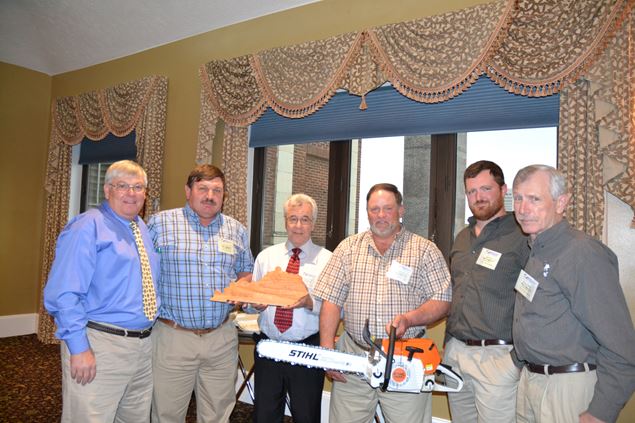
The Kentucky Forest Industries Association (KFIA) recently completed a successful 49th Annual Meeting in Louisville, Kentucky at the historic Brown Hotel. The meeting was held April 2-4, 2014 and was well attended by over 350 members. The KFIA Annual Meeting serves as the premier event for the hardwood industry in Kentucky and got underway with a great day of golf that included a record turnout of over 80 golfers.
Thursday started with the Board of Directors taking care of association business and was followed by the KFIA/Tree Farm Awards Luncheon. The luncheon provided an opportunity to honor a wide range of individuals that help to make forestry and the wood industry a big success throughout the state. The following people were recognized for their contributions to forestry in Kentucky:
Harry & Karen Pelle, Bradfordsville, KY – 2013 Tree Farmer of the Year
Allen’s Logging LLC, Shepherdsville, KY – 2013 Logger of the Year
Connie Woodcock, Central Region Kentucky Division of Forestry, Campbellsville, KY- 2013 Inspector of
the Year
Renee Williams, University of Kentucky Forestry Extension, Lexington, KY–2013 Communicator of the Year
KFIA recognized the following people for their leadership and service to the KFIA Board of Directors:
Secretary Treasurer - Yvonne Bradley, Homer Gregory Co. - Morehead, KY
Director – Chuck Courtney, Courtney Timber Harvesting – Greenville, KY
The following people were elected to the 2014 KFIA Board of Directors:
President— Darrin Gay, Gay Brothers Logging & Lumber - Oneida, KY
Vice President— Tony Leanhart, Northland Corporation - LaGrange, KY
Secretary/Treasurer— Amy Conley, Diamond Forest Resources - Morehead, KY
Re-elected Directors: Casey Goodman, C.B. Goodman & Sons Lumber - Hickory, KY
Ronnie Robinson, Robinson Stave Co. - East Bernstadt, KY
New elected Directors
Darryl Centers, Patterson Chip Co. - Barbourville, KY
Mervin Strader, Strader Bros. LLC. - Elkton, KY
Mike Gomes, Wonderfuel LLC - Somerset, KY
The afternoon included meetings discussing the hot topic of the Hardwood Check-off and Sustainable Forestry Implementation in Kentucky, as usual tradition, everyone enjoyed the Robinson Lumber/Van Meter Insurance Hospitality Suite with great seafood and special cuisine straight from New Orleans. The day concluded with the Exhibitor Reception and plenty of time to see some of the latest technology and services being offered to the wood industry.
Friday morning opened with a state legislative and association update by KFIA Executive Director Bob Bauer. Other conference speakers were Joe Collins, Office of the State Entomologist who provided an update on the Emerald Ash Borer and Thousand Cankers Disease plaguing the industry. Bob Russell, Brown-Forman Cooperage gave an update on the recent growth in the bourbon and stave markets and Matt Bynum, Louisville Slugger Factory explained how the Emerald Ash Borer is affecting the bat making process and how the tree becomes a bat.
The meeting was a tremendous success and those in attendance gained valuable information while having time to network with others in the hardwood industry from throughout the country. KFIA is pleased to announce that the 2015 Annual Meeting will be in Lexington, KY at the Embassy Suites on March 25-27.
KFIA is a trade association dedicated to serving and promoting the forest products industry of Kentucky. Founded in 1965, it has over 600 members in the areas of primary and secondary wood industry, supplier and service industries, wholesale, loggers and landowners. KFIA promotes sound forest management through the Sustainable Forestry Initiative. For more information about the association contact Bob Bauer at 502/695-3979.
By: Kentucky Forest Industries Association
Back in 1989, The Cleereman-Jacquet Lumber Company was doing business in Green Bay. Brother-in-law Bill Cleereman and John Jacquet were the principal players in the operation. The company purchased land in the newly-formed Forest County near Newald, and from their logging camps, logs were sawed and given a sleigh ride to the Soo Line Railroad and after a change of railroads arrived at their mill. The Chicago & Northwestern Railroad was building a north-south line in the years that followed, reach Wabeno in 1897 and finally laying track through Newald in 1911.
The Cleereman-Jacquet Lumber company packed everything up and moved their operation north to Newald, and built a steam-powered sawmill, housing, barns, camps and all of the infrastructure needed to run a sawmill and logging operation.
Francis Cleereman was born in Newald, raised around the sawmill and all of the characters that went with a business in the wilds of northern Wisconsin. He learned much about millwrighting from a fellow named Tom Kleve, graduated from high school in Laona and went on to serve his country in the Army in the European Theatre in WWII. When his stint in the war ended, he came back to Newald and went to work. The Jacquet family was no longer involved in the business after the war, and Bill Cleereman was the sole owner.
But, sawmilling had changed through the years. The business was more competitive, and according to Francis, in an interview with him 20 years ago, his father, Bill Cleereman decided in the early 1950's that it was fruitless to run the mill anymore, but Francis had some ideas. One of those ideas was to modernize the sawmill carriage and eliminate the people it took to handle a log on a carriage. No longer would there be someone riding the carriage back and forth all day long, logs were turned and positioned by an operator, the head sawyer, sitting in a booth using the buttons at his fingertips to use electricity and compressed air to do the work that used to require three men.
Francis Cleereman had no idea at the time that he had started a revolution in how sawmills would be run. The beginning of this revolution came when Francis looked out of the millwright's shop and saw a man watching the carriage work. Thinking he was a lumber buyer, he stepped out to see if he could be of help. This Upper Peninsula sawmill operator had heard of the new Cleereman automated carriage and after watching it for a few minutes, decided he had to have one. Francis, however, had a different idea. He told him that they were sawmill operators and not manufacturers of sawmill equipment. A heated argument ensued, and then his father showed up. He told his son that he had plenty of time to make a mill and, after all, he was going to be paid to do it. Francis made the mill, then was accosted by another mill owner who wanted the new technology. The easy days of keeping the Cleereman sawmill were over. The word spread, and by 1969, the Cleereman sawmill carriage was the industry model of excellence that all of his competitors strived for.
1969 is also the year that the Cleereman family left the lumber business. The first Saturday of October, Bill Cleereman suddenly passed away, and Francis said they never sawed another board.
Sons Fran and John joined their father in the business, and they continued to supply sawmill carriages to sawmill men throughout the United States and Canada.
As the years passed, the two brothers and their father continued to work on the original design, improving whenever and wherever they could, meeting the needs of the sawmill industry. Time caught up with Francis eventually, and he passed away, leaving the business in the hands of two sons who were also very adept at making mills and designing new innovations.
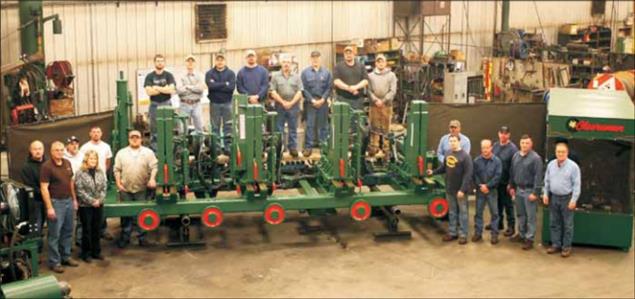
That is still the case at Cleereman Industries in Newald. Since then, John retired from the business, and Fran took on two new investors and helpers, Jeff Krueger and Rod Chitko.
Like their predecessors in the business, they are always looking for new and better ways to serve the sawmill industry. After surviving the economic collapse of 2008, when much of the work in the shop was the repairing of used carriages for owners who might have wanted to buy new but didn't want the debt. Things have changed in recent times. When you look at the chalkboard listing upcoming projects, you are looking at a year's work building sawmill equipment.
The gang at Cleereman Industries isn't done with innovation either. They now offer whole systems, not just a sawmill carriage and the saw. With any mill, there is also a vast array of machines to handle materials and keep the flow of lumber, slabs and sawdust moving away from the saw and into the proper places. They also offer a new type of mill.
The new Lumber Pro model breaks with the traditions of a carriage carrying the log through the saw. Instead, the saw moves through the log. There is no longer a moving carriage, but a place to rest the log and turn it as the saw moves back and forth. The three manufacturers, Fran, Jeff and Rod explained that this system is more energy and operator efficient, with up to $600 savings on the electrical bill in some instances. The Lumber Pro is also easier and quicker to install.
The 1000th Cleereman sawmill carriage milestone took 60 years to reach, and it would be impossible to estimate the board feet of lumber sawed on Cleereman equipment in that length of time. My guess is that you could build a boardwalk to the moon.
The owner of this mill is W.R. Deacon and Sons from Lexington, Virginia. He is trading in a 1995 model for the new one, not because it has worn out, but he wants to leave his mill to his sons, and wants them to start out with a new Cleereman system. He bought his first back in 1987, and he knows they work. Fran said they will do some work on his trade-in and sell it to another owner.
There is one exception to the technological advancements made at this Forest County company. That is the Amish market. They seem to like the Cleereman carriages very much, but they won't use electricity and always want the old designs that started this march to mill number 1000, and they use a diesel engine to power it. They still work as well as the did 60 years ago.
When visiting the Cleereman plant in Newald, I thought back to when I did a history on the Cleereman sawmill carriage twenty years ago and spent time with its inventor, Francis Cleereman. He was a pugnacious man with an unlimited work ethic, but he also had a great joy in being the cantankerous old guy who loved to pick arguments with his sons, even if he secretly agreed with them. I might add that they also liked the exchange and often started the argument. I thought that Francis would be extremely proud of this company that he had begrudgingly started at the insistence of his father, but he probably wouldn't admit it.
By Mike Monte, Editor, Pioneer Express
By: Cleereman Industries
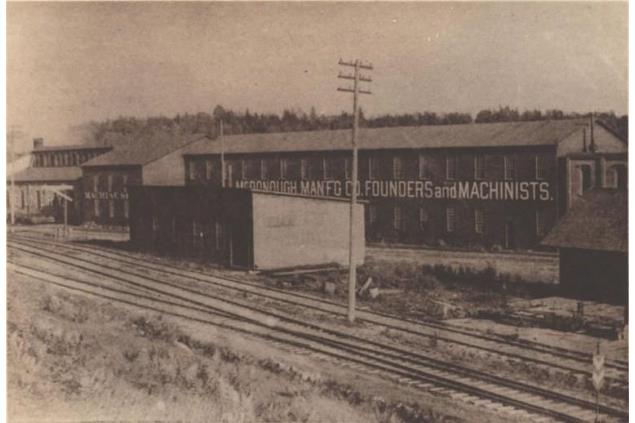
Frank McDonough started a company to build custom made equipment that was better than anything being built at that time, with a focus on Efficiency, Production, Design, Durability, Simplicity and Strength. Today, 125 years later, we are proud to say we are continuing Frank’s legacy. On November 13th, McDonough will be hosting an open house from 3:00 pm – 6:00 pm to celebrate our 125th birthday. When Frank incorporated in 1888, McDonough Manufacturing started out servicing sawmills in the Eau Claire area as well as other mills around the State. Today, McDonough’s customer list spans the globe to countries like Australia, New Zealand, Austria, France and Brazil. McDonough’s product line has also grown to include: bandsaws for headrig and resaw applications, log carriages, linebar resaws, horizontal resaws, center-splitting resaws, lineal or transverse optimized board edgers, gang edgers, manually fed edgers and industrial drill bit grinders. For more information contact McDonough Manufacturing at (715) 834-7755.
By: McDonough Manufacturing Co